

Sacsayhuaman Fortress is one of the world’s most astonishing archaeological complexes. Located just outside the northern part of Cusco, Peru, Inca Pachacutec initiated its construction in the 15th century, with his successors continuing the work.
This remarkable site showcases pre-Columbian engineering and serves as a gateway through time, connecting us to the mystical world of the Incas. Sacsayhuaman is a masterpiece of architecture, history, and spirituality, from its massive zigzagging walls to breathtaking panoramic views. Get ready to explore the grandeur of the Incan Empire!
What is Sacsayhuaman?
Sacsayhuaman was an ancient temple in Peru where rites and sacred ceremonies were dedicated exclusively to the Sun God, “Inti.” This site held significant spiritual importance, second to the Temple of Qoricancha.
With the arrival of the Spanish, Sacsayhuaman transformed a ceremonial to a military purpose, becoming a key stronghold of resistance against the invaders. Today, it displays its social organization and architecture at its finest, encapsulating a crucial historical and cultural space for Peru and the whole of America.
How do you pronounce “Sacsayhuaman”?
The correct pronunciation of the iconic Sacsayhuaman in Cusco, Peru, closely resembles “sak-say-wah-man.”
Location
Sacsayhuaman in Peru lies about 2 kilometers north of Cusco’s Plaza de Armas, at 3,700 meters above sea level. Spanning over 3,000 hectares on a hill surrounded by mountains, it can be reached in roughly 10 minutes by car from Cusco’s Plaza de Armas or by taking a 45-minute scenic walk.
What does “Sacsayhuaman” mean?
The name “Sacsayhuaman” harbors various interpretations brimming with history and mystery. Here are three explanations to bring you closer to the meaning of this word:
Etymologically, Sacsayhuaman stems from the Quechua word “saqsay,” meaning full or satisfied, and “waman,” meaning falcon, translating to “satisfied falcon” in Spanish. This interpretation connects us to an Incan mythical figure: the tutelary deity of Manco Qhapaq, considered the protector of the first Inca, represented as a falcon carried as an emblem in conquests.
Another meaning comes from “Saccsa,” meaning beaten corn, and “uma,” meaning head, translating to “fortified head hill.” This term refers to the fortress’s puma shape north of Cusco.
A third suggestion is that Sacsayhuaman derives from “Saxea,” a Greco-Latin adjective meaning stone, and “haman,” meaning city, forming “Saxea-haman” or “stone city.”
History
Pre-Inca Era of Cusco:
From 900 to 1200 AD, the Ayarmaca culture, known as Killke, thrived in the Cusco region, particularly in Sacsayhuaman. They developed advanced structures and terraces there, showing their pre-Inca ceremonial significance. These constructions and findings in Marcavalle, Lucre, and possibly the Chanapata culture highlight Cusco’s rich cultural heritage before the Incas.
Inca Era: Construction of Sacsayhuaman, Peru
Pachacútec designed the Fortress of Sacsayhuaman, and more than 20,000 men from Tahuantinsuyo, working under the mita system (teamwork), divided their tasks among stone extraction, transport, and foundation preparation, combining their forces to build the House of the Sun. This construction showcases the extraordinary organizational and technical capacity of the Inca Empire.
Colonial Era: Transformation of Sacsayhuaman
When the Spanish arrived, Sacsayhuaman shifted from a ceremonial center to a pivotal battlefield in the Inca resistance, particularly during the battle of Sacsayhuaman. The Ecclesiastical Cabildo of Cusco dismantled the site in 1559. They repurposed its stones to construct colonial buildings, such as the Cusco Cathedral, symbolizing the imposition of Spanish culture onto the Inca legacy.
Republican Era:
After gaining independence from Spain, the Sacsayhuaman Fortress entered a phase of neglect and progressive deterioration. Two years later, the complex was forgotten and buried by the mandate of Catholic authorities.
Sacsayhuaman today:
Today, Sacsayhuaman is a powerful symbol of cultural identity, defined by its deep historical, spiritual, and magical-religious value linked to Cusco.
Architecture
The architecture of Sacsayhuaman is notable for its impressive and sacred construction, which includes residences and towers, sanctuaries, warehouses, and aqueducts. This magnificent work perfectly integrates with the landscape and reflects a spiritual connection with other sacred sites, like Machu Picchu.
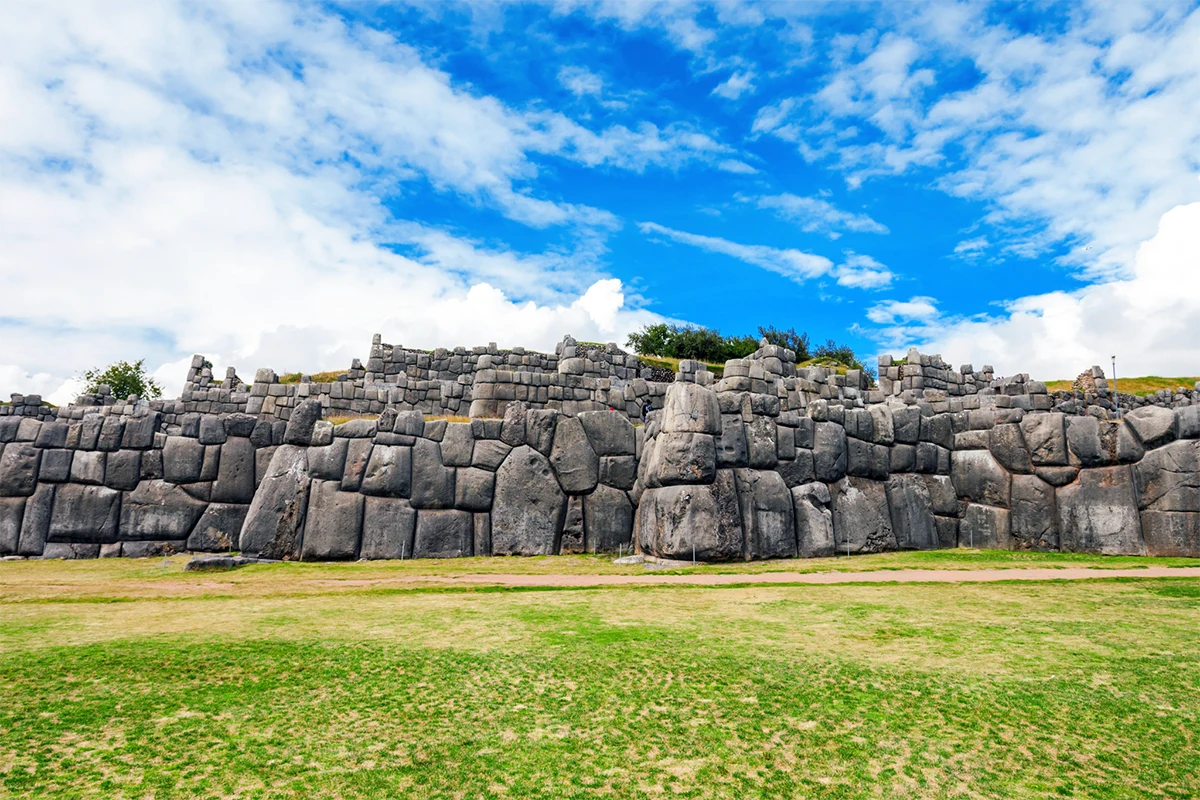
The iconic main wall of Sacsayhuaman, built in a zigzag design, features colossal stones reaching up to 5 meters in height and 2.5 meters in width, with a weight that varies between 90 and 125 tons.
The renowned Peruvian chronicler Inca Garcilaso de la Vega hailed Sacsayhuaman as the pinnacle of Inca engineering in its heyday. This site is a testament to the Incas’ advanced architectural knowledge and demonstrates their deep connection with the cosmos and the surrounding land.
Characteristics of Sacsayhuaman’s Architecture
Sacsayhuaman stands as a structure of massive stones carved and placed with astonishing precision. The ancient technology the Incas used to build it remains a complete mystery.
- The fortress features impressive megalithic walls, citadels, and underground chambers.
- Architecturally, its three extensive walls, made of colossal stones, are the most striking aspects.
- These gigantic stones fit together perfectly without the need for any external materials.
- While it lacks elaborate decorations, its visual impact is still profound.
- The stones of its walls reveal various symbols of animals typical of the region, carved by the Incas.
- Its square design provided a panoramic view of Cusco through its windows, allowing detailed observation from within.
What to see in Sacsayhuaman?
Besides the fantastic view of Cusco, Sacsayhuaman offers many other sights:
The Cyclopean Ramparts
These imposing terraces, named “Illapa” in honor of the thunder god, are characterized by their enormous limestone rocks in zigzagging levels and reflect Inca architectural mastery. Three main gateways – T’iu Punku, Ahawanapunku, and Wiraqocha Punku – stand out, evidencing different construction phases.
The Muyucmarca Pyramid
This ceremonial and socio-political construction is part of a truncated stepped pyramid. At its top platform lie the foundations of Muyucmarca, Paucarmarca, and Sallaq Marca, with names linked to the population, festivity, and ruggedness.
Southern Terraces/Cruz Moqo
The Ayarmaca or Killke culture constructed six semicircular terraces using green diorite, highlighting Sacsayhuaman’s significance as a ceremonial site.
Rumipunku
This stone gateway connects to the Chuquipampa esplanade and stands out for its impressive stone canvas. It served as a control and access point, highlighting the Inca’s organizational skills.
Rodadero or Suchuna
These features, known as the slides of Sacsayhuaman, stand out for their natural diorite rock outcrops and remarkable curved surfaces.
The Inca Throne
Also known as K’usillu’s Hink’inan, this ceremonial site is located at the highest point of Suchuna, offering a panoramic view of the archaeological complex.
The Inka’s Bath
This structure, linked to a water source and aqueducts, served a ceremonial purpose. It was complemented by nearby enclosures, of which only traces now remain.
Qocha
This circular structure features three concentric terraces, creating a space of significant ritual importance.
Chincanas (tunnels)
The chincanas, or tunnels and underground caves at Sacsayhuaman, fascinate visitors with their mysterious construction. Two exist: a smaller one, stretching about 15 meters, offers an enticing diversion for many travelers, and a larger one situated north of the complex.
Legends recount numerous unsuccessful attempts to discover the end of the longer tunnel, which many believe connects to Qoricancha (Temple of the Sun). Currently, the public needs access to this larger chincana.
Weather
Sacsayhuaman’s climate is dry and mild, averaging 12 °C (54 °F). Cusco experiences two seasons throughout the year: a rainy season from November to March and a dry season from April to October.
What is the best time to visit Sacsayhuaman?
If you plan to visit the Sacsayhuaman stones, the ideal time is during the dry season (April to October). The weather is mostly dry, and temperatures are pleasant, promising a perfect experience for exploring the archaeological site and enjoying its breathtaking views.
Additionally, if you visit in June, you’ll have the chance to witness the Inti Raymi, known as the “Festival of the Sun,” one of Cusco’s most essential and spectacular celebrations held every June 24th.
How do you get to Sacsayhuaman?
To reach Sacsayhuaman from downtown Cusco, you have several options:
On foot: It’s a short but steep walk that will take 30 to 45 minutes. Head north from Cusco’s Plaza de Armas, climbing the narrow streets. It’s a good workout and lets you enjoy stunning city views as you ascend.
By taxi: If you prefer to save energy for exploring the ruins and discovering the Sacsayhuaman mystery, taking a taxi is convenient and affordable. The trip takes about 10 minutes and drops you right at the entrance. Be sure to agree on the fare with the driver beforehand.
By tourist bus: Some companies offer tours, including Sacsayhuaman and other nearby archaeological sites. It’s a good option if you’re also interested in visiting places like Qenqo, Puca Pucara, and Tambomachay on the same day.
On a guided tour: This is the best option, as you won’t have to worry about anything except enjoying your visit. Booking a guided tour from Cusco is an excellent way to get historical and cultural context while visiting.